Payment Tokenization in UAE: How Network Tokens Reduce PCI DSS Scope and Cost
How payment tokenization and network tokens reduce PCI DSS scope for UAE merchants and fintechs - architecture patterns, scope reduction strategies, and cost savings.
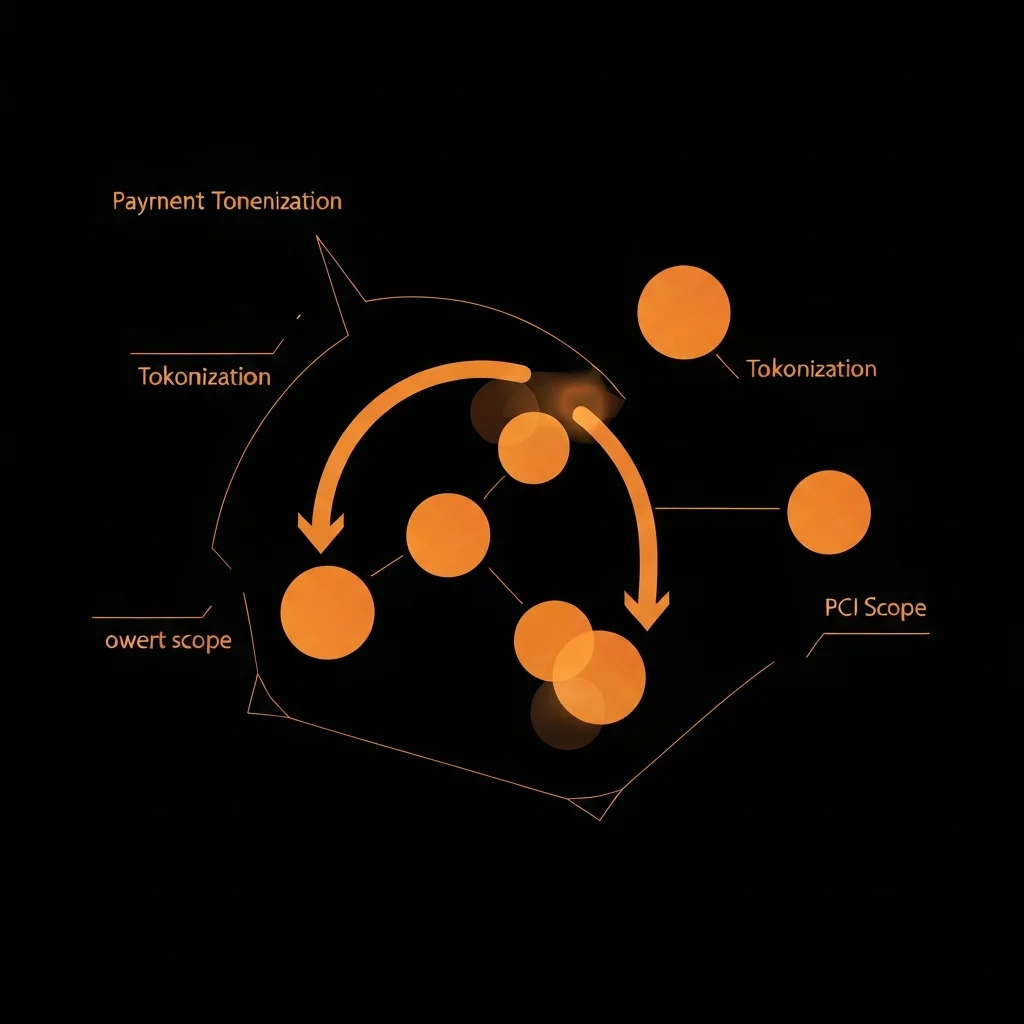
If your UAE business stores, processes, or transmits primary account numbers (PANs), every system that touches that data falls within your PCI DSS scope. More scope means more controls, more evidence, more audit effort, and more cost. Payment tokenization is the most reliable way to shrink that scope - replacing sensitive card data with non-reversible tokens that carry zero value if breached.
This guide explains how network tokenization, vault-based tokenization, and point-to-point encryption (P2PE) work in the UAE payment ecosystem - and how to architect your payment flows so that card data never enters your environment in the first place.
What is Payment Tokenization?
Payment tokenization replaces a card’s primary account number with a surrogate value - a token - that cannot be reversed to recover the original PAN without access to the token vault. The token can be stored, transmitted, and referenced in your systems without triggering PCI DSS requirements for those systems.
There are two fundamentally different types of tokenization that UAE businesses encounter:
Acquirer or PSP tokens are generated by your payment gateway or processor. When you integrate with Network International, Checkout.com, Stripe, or Adyen in the UAE, the gateway captures the card number and returns a token that represents it. Your systems only ever see the token - never the PAN. This is the most common form of tokenization for UAE e-commerce merchants.
Network tokens are issued by the card networks themselves - Visa Token Service (VTS) and Mastercard Digital Enablement Service (MDES). A network token replaces the PAN at the network level, meaning the token is recognized by issuers and can be used for authorization without the original card number ever being present in the transaction chain. Network tokens also deliver higher authorization rates (typically 2-4% improvement) and automatic card-on-file updates when a cardholder’s physical card is reissued. AI shopping agents add another token type on top of this, and our guide to PCI DSS scope for agentic commerce explains how agent tokens and delegated credentials affect your CDE.
How Tokenization Reduces PCI DSS Scope
PCI DSS scope is determined by the presence of cardholder data - specifically the PAN. Any system that stores, processes, or transmits the PAN is in scope. Any system connected to an in-scope system is also potentially in scope. This cascade effect is why scope grows rapidly in environments without clear segmentation.
Tokenization breaks this cascade. When a token replaces the PAN before data enters your environment, the systems handling that token are out of PCI DSS scope - provided the token meets specific criteria:
The token must not be reversible by any system in your environment. If your application can call an API to detokenize and retrieve the original PAN, the application server is in scope.
The token format must not preserve the original PAN structure in a way that allows derivation. A token that retains the first six and last four digits of the PAN while randomizing the middle is still considered cardholder data for scope purposes.
The token vault must be operated by a PCI DSS-compliant third party. If you run your own token vault, the vault and all connected systems remain in scope.
For a typical UAE e-commerce merchant using a fully hosted payment page (redirect or iframe) with PSP tokenization, the scope reduction is dramatic. Instead of all web servers, application servers, databases, and network infrastructure being in scope, only the redirect mechanism and the merchant’s security policies require assessment - often qualifying for SAQ A, the shortest questionnaire with just 22 requirements.
Network Tokens vs. PSP Tokens in UAE
UAE merchants and fintechs often conflate network tokens with gateway tokens. Both reduce scope, but they operate differently and deliver different benefits.
PSP tokens are proprietary to your payment processor. A token from Network International cannot be used with Checkout.com. If you switch processors, you need to migrate tokens or re-collect card data. PSP tokens reduce your PCI DSS scope effectively but create processor lock-in.
Network tokens are portable across processors because they are issued by Visa or Mastercard directly. They travel through the payment network like a real PAN but are cryptographically bound to your merchant ID and a specific device or channel. Key advantages for UAE businesses include:
Higher authorization rates. Network tokens include a cryptogram that proves the token is being used by the authorized merchant, reducing issuer declines. UAE merchants processing recurring payments or card-on-file transactions typically see 2-4% authorization improvement.
Automatic card updates. When a cardholder’s bank reissues a card (expiry, replacement, fraud), the network token is automatically updated. This eliminates the “card on file expired” problem that causes involuntary churn for UAE subscription businesses.
Reduced fraud liability. Transactions authenticated with network tokens shift liability in ways similar to 3D Secure, depending on the card brand’s specific rules.
Cross-processor portability. If you switch from Network International to Adyen, your network tokens continue to work without re-collecting card data.
In the UAE market, Network International, Checkout.com, and Adyen all support network tokenization through their gateway integrations. Stripe supports network tokens for eligible merchants with automatic enrollment. For most UAE businesses, network tokens are provisioned transparently by the PSP - no direct integration with VTS or MDES is required.
Architecture Patterns for Maximum Scope Reduction
The goal is to ensure that cardholder data never enters your environment. Here are the three architecture patterns that achieve this for UAE payment flows.
Pattern 1 - Hosted Payment Page (Redirect)
The customer is redirected to the PSP’s hosted payment page to enter card details. Your servers never see the PAN. After payment, the PSP returns a token and transaction result to your callback URL.
PCI DSS impact: Qualifies for SAQ A. Only 22 requirements to assess. No quarterly ASV scans required for most implementations. This is the lowest-cost compliance pathway for UAE e-commerce merchants.
Tradeoff: Limited control over the checkout UX. The payment page looks and feels like the PSP’s page, though most UAE processors offer customizable hosted pages.
Pattern 2 - Embedded Payment Fields (iFrame or SDK)
The PSP provides JavaScript fields (Stripe Elements, Checkout.com Frames, Adyen Web Components) that render inside your checkout page but capture card data directly into the PSP’s environment. Your page contains the fields visually, but your servers and JavaScript never access the PAN.
PCI DSS impact: Qualifies for SAQ A-EP (e-commerce with partial outsourcing). This is a longer questionnaire than SAQ A - around 140 requirements - because your website’s JavaScript execution environment could theoretically be compromised to intercept card data before it reaches the PSP’s iFrame.
Tradeoff: Better UX control than a redirect, but more PCI DSS scope. For UAE businesses processing high volumes where checkout conversion matters, this is often the right balance.
Pattern 3 - P2PE for In-Store (POS)
Point-to-Point Encryption (P2PE) encrypts card data at the point of interaction (the payment terminal) using hardware-managed keys. The encrypted data travels through your network to the processor without your systems being able to decrypt it.
PCI DSS impact: P2PE-validated terminals reduce in-store PCI DSS scope dramatically. A UAE retailer with validated P2PE terminals can qualify for SAQ P2PE - just 33 requirements, focused on terminal management and physical security rather than network segmentation or server hardening.
UAE context: Ingenico and Verifone terminals deployed by Network International and other UAE acquirers support P2PE. However, P2PE validation is specific to the solution - confirm that your exact terminal model and processor combination appears on the PCI SSC’s list of validated P2PE solutions.
Calculating the Cost Impact
Scope reduction translates directly to compliance cost savings. Here’s what UAE businesses typically see:
SAQ D (full scope) requires assessment against all 12 PCI DSS requirements and over 300 sub-controls. For a Level 2 merchant, this typically requires a dedicated compliance project of 3-6 months and AED 80,000-200,000 in consultant and remediation costs.
SAQ A-EP (tokenized e-commerce with embedded fields) covers approximately 140 requirements. Typical compliance project: 4-8 weeks, AED 25,000-60,000.
SAQ A (fully outsourced with redirect) covers 22 requirements. Typical compliance project: 1-2 weeks, AED 10,000-20,000.
The difference between SAQ D and SAQ A can be AED 70,000-180,000 per year in ongoing compliance costs - plus the reduced risk of assessment failure and the operational savings from not managing cardholder data in your environment.
For Level 1 merchants requiring an on-site QSA assessment, scope reduction doesn’t change the assessment type but significantly reduces the assessment duration and cost. A QSA audit of a tokenized environment with clear segmentation typically takes 40-60% less time than an equivalent audit of a full-scope environment.
Common Tokenization Mistakes in UAE
Logging the PAN before tokenization. Some UAE implementations capture card data in application logs, error handlers, or analytics systems before the tokenization step. If any system records the PAN - even briefly, even in an error log - that system is in scope.
Detokenization for business analytics. Marketing teams sometimes request the original card number (or first six digits) for BIN analysis, customer segmentation, or fraud pattern detection. Any system that detokenizes is fully in scope. Use the PSP’s analytics dashboards instead, or request truncated PAN data (first six, last four) that the PSP provides alongside the token.
Assuming all tokens are equal. A token that preserves the PAN format (same length, passes Luhn check) may be treated as cardholder data by conservative QSAs. Clarify with your assessor how format-preserving tokens are treated in your specific assessment.
Forgetting about the token-to-PAN mapping. If you operate your own token vault (common in large UAE banks and PSPs), the vault itself is a high-value target and remains fully in scope. The vault’s security controls, access management, and key management must meet the strictest PCI DSS requirements.
Getting Started with Tokenization in UAE
The implementation path depends on your current architecture:
New builds: Choose a PSP that supports network tokens and use their hosted payment page or embedded fields from day one. Architect your systems to never receive or store the PAN. This is the simplest path and the one we recommend for every new UAE e-commerce build.
Existing card-on-file systems: Work with your PSP to migrate stored PANs to tokens. Most UAE processors offer bulk tokenization services. Plan for a migration window, update your recurring billing integrations to use tokens, then decommission PAN storage and re-assess your PCI DSS scope.
In-store retailers: Evaluate P2PE-validated terminal solutions from your acquirer. Replace non-P2PE terminals and update your SAQ type accordingly.
Book a free tokenization and scope reduction call with pcidss.ae to assess your current payment architecture and identify the fastest path to reducing your PCI DSS scope and compliance costs.
Frequently Asked Questions
Does payment tokenization remove my UAE business from PCI DSS entirely?
Not entirely, but it dramatically reduces your PCI DSS scope. With a fully hosted redirect checkout, tokenization can shrink your obligation to SAQ A - just 22 requirements. However, the scope depends on how the token is implemented: if your systems can detokenize or if you run your own token vault, those systems remain fully in scope.
What is the difference between a PSP token and a network token in the UAE?
PSP tokens are proprietary to your payment gateway (Checkout.com, Stripe, Adyen) and create processor lock-in. Network tokens are issued by Visa or Mastercard directly, work across processors, deliver 2-4% higher authorization rates, and update automatically when a cardholder's physical card is reissued - making them the better choice for subscription or card-on-file businesses.
How much money can tokenization save on PCI DSS compliance costs in the UAE?
The savings are significant. Moving from SAQ D to SAQ A can reduce annual compliance costs by AED 70,000-180,000, based on typical UAE consultant and remediation spend. SAQ D projects run AED 80,000-200,000; SAQ A projects run AED 10,000-20,000. For Level 1 merchants needing a QSA audit, a tokenized environment typically cuts assessment time by 40-60%.
Which checkout architecture qualifies a UAE e-commerce merchant for SAQ A?
A fully hosted payment page (redirect) qualifies for SAQ A. The customer is redirected to the PSP's domain to enter card details - your servers never see the PAN. Embedded JavaScript widgets like Stripe Elements or Checkout.com Frames require SAQ A-EP instead, which covers roughly 140 requirements rather than 22.
What are the most common tokenization mistakes UAE merchants make?
The three most frequent errors are: logging the PAN before tokenization in error handlers or analytics systems; requesting detokenization for business analytics (which brings the analytics system into scope); and assuming format-preserving tokens are out of scope - tokens that retain the same length and pass the Luhn check may still be treated as cardholder data by conservative QSAs.
Complementary NomadX Services
Start Your PCI DSS Journey
Book a free 30-minute compliance discovery call with our PCI DSS specialists in Dubai. We assess your current posture and identify the fastest path to compliance - actionable findings in days.
Every engagement is scoped by our principal architect, Adrian Vale: 20+ years in production engineering, 40+ professional certifications. Meet Adrian
Talk to an Expert